
For most of its existence, Remoti operated in relative obscurity, doing the unglamorous work of connecting Latin American professionals with international companies and managing the compliance headaches that followed. On April 14, at a private event in Bogotá gathering investors, business leaders, and technology executives, the company tried something different: it made a strategic argument.
Building a team in Colombia — or anywhere in Latin America — should be as operationally simple as subscribing to a software service. The company’s new “Workforce-as-a-Service” (WaaS) model and Remoti App are the vehicle for that claim, and the market conditions are genuinely moving in its favor.
The numbers are hard to ignore. Colombia’s IT outsourcing market is projected to reach $803 million in 2025, growing at 7.37% annually to reach $1.15 billion by 2030, according to Statista.
Beyond cost, Colombia shares the U.S. Eastern time zone, enabling the kind of real-time collaboration that offshore alternatives in Asia simply cannot offer.
Deloitte estimates that over 60% of U.S. companies are currently considering nearshoring operations, with Colombia among the leading destinations.
What Remoti is proposing goes beyond helping companies find and hire those professionals — the WaaS model covers the full employee lifecycle: sourcing, contracts, compliance with Colombian labour law, payroll, benefits, and the broader experience of being part of a globally distributed team. The Remoti App packages this into three layers — talent sourcing, workforce operations, and a marketplace of financial products built for workers themselves, not just the companies employing them.
“The world changed and companies need new ways to build and operate global teams,” said Pablo Miller, CEO and founder. “With Workforce-as-a-Service we are allowing companies to integrate talent in Latin America with the same flexibility with which they today scale technology in the cloud. And at the same time, we are enabling a more structured, reliable and supported experience for the region’s talent.”
That worker-facing dimension is less common in this space, and arguably more relevant as the regulatory environment continues to shift. The WEF’s Future of Jobs Report 2025 found that 61% of Colombian firms cite outdated or inflexible regulatory frameworks as a barrier to business transformation, making compliance navigation a genuine value-add rather than a background function.
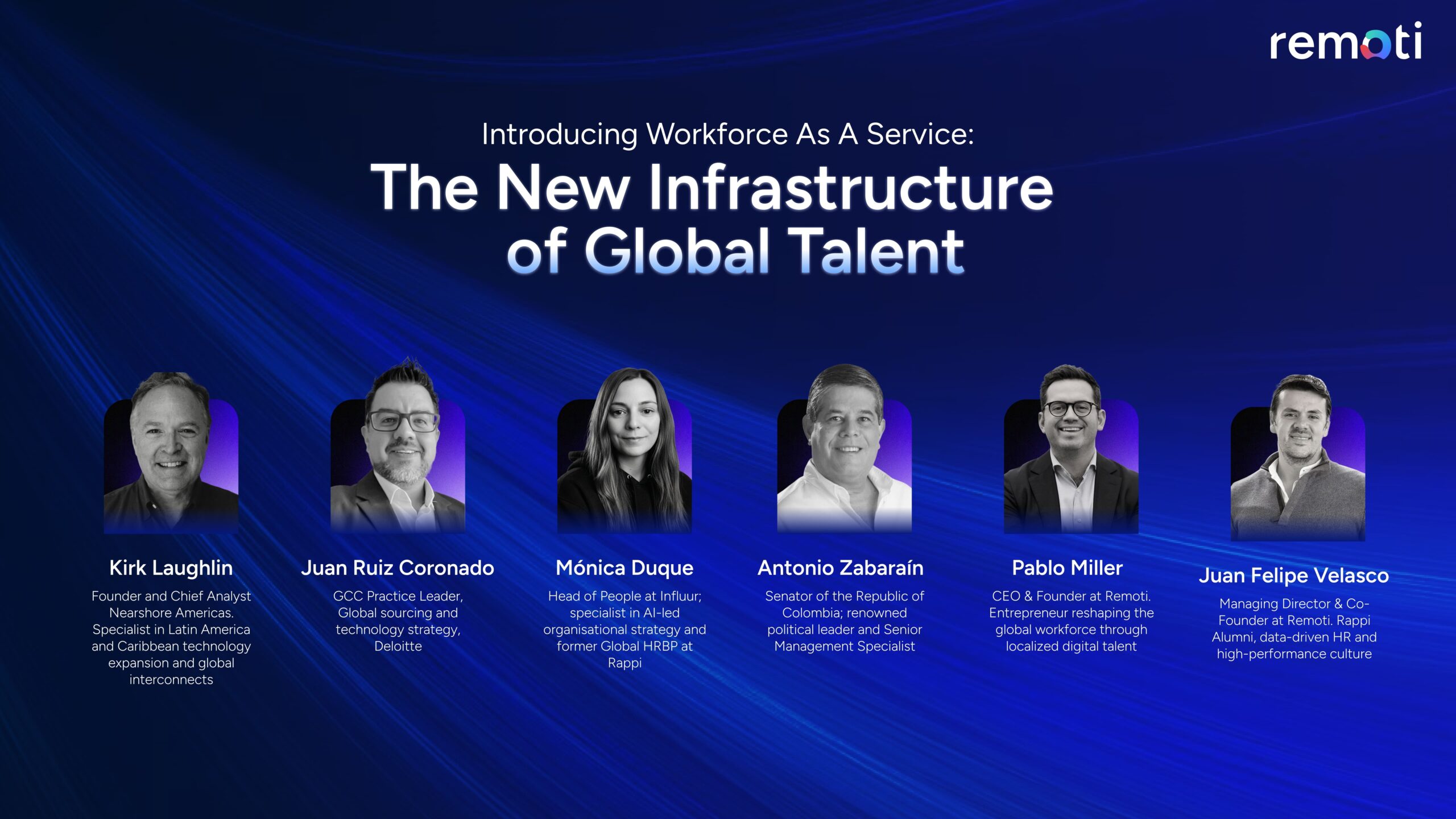
The launch event brought together a deliberate mix of business and policy voices. Deloitte’s Juan Ruiz Coronado spoke on Latin America’s role in global talent ecosystems, Influur’s Mónica Duque addressed the technology infrastructure behind distributed teams, and Christopher Snyder, Senior VP Engineering at Cast and Crew, offered an enterprise perspective on adoption at scale.
Congressman Antonio Zabarain, who sponsored legislation to advance Colombia’s technology sector, joined a panel on regulation and the country’s readiness as a global talent hub — a signal that this is now as much a matter of national economic strategy as corporate convenience.
“This launch marks a structural change in how organisations think about redistributing their operations and accessing talent,” said Juan Felipe Velasco, co-Founder and managing director. “It is the result of nearly 10 years building, operating and perfecting a model with international companies, until consolidating it into a clear proposition.”
The employer-of-record space is competitive — Deel, Rippling, and Oyster operate at scale globally — and Remoti’s claims to differentiation through regional depth and a managed-service approach will be tested in practice. But as Bogotá works to position itself as more than a source of affordable labour, platforms that can handle the full complexity of cross-border employment, on both sides of the equation, may find the timing is right.
Featured image: Courtesy of Remoti

Disclosure: This article mentions clients of an Espacio portfolio company.