
The session on the region’s next unicorns brings together founders from Brazil, Colombia, Mexico, and the United States. The one on entrepreneurship across Latin America adds Peru and Uruguay. Fintech is mostly Colombian and Venezuelan. That spread is the enticing value proposition the Horasis Global Summit brings, which runs from 10 to 13 November at Universidad de Medellín.
Horasis, the Swiss think tank behind it, projects more than 1,000 business leaders, government figures, innovators, and thinkers, with the City of Medellín as co-host. For the region’s tech sector, the agenda is the interesting part. It is specific about problems that cross borders.
Where the money comes from
One session is devoted entirely to Colombia as a destination for long-term capital. Called “Colombia as a Long-Term Investment Horizon,” it brings together the foreign direct investment representative of ProColombia, a Deloitte partner, a private equity fund coordinator, and two investment firms. The programme lists what they will examine: regulatory clarity, institutional strength, and the sustainability alignment investors look for before committing.
A wider session, “Building Entrepreneurial Pathways Across Latin America,” takes up a problem most founders will recognise. The programme notes that Latin America combines “a young talent base, growing digital adoption, and expanding entrepreneurial ambition,” but that progress remains uneven between countries. Its panel comes from Brazil, Colombia, Peru, and Uruguay, and it asks how regional cooperation can let innovation scale beyond national borders.
Fintech has a session of its own, with founders from Lineru, TuBanc, Finti, Avanzo, and Venezuela’s Finity Tech. The programme describes a sector “moving from disruption to infrastructure.” Less about launching new apps, more about running the payment and lending systems other businesses depend on.
How companies scale
The unicorn session is about discipline rather than speed. It argues that the next generation of large companies will come from founders who combine technology, execution, and market timing. Scaling globally, the programme says, now depends on “stronger fundamentals, smarter capital, and ecosystems that support long-term growth rather than rapid valuation alone.”
The host city is a working example. Startups in Medellín have raised US$216 million so far this year, 38% more than in the same period of 2025, according to Forbes Colombia, and the city entered StartupBlink’s global ecosystem index at 130th, climbing fifteen places.
Who does the work
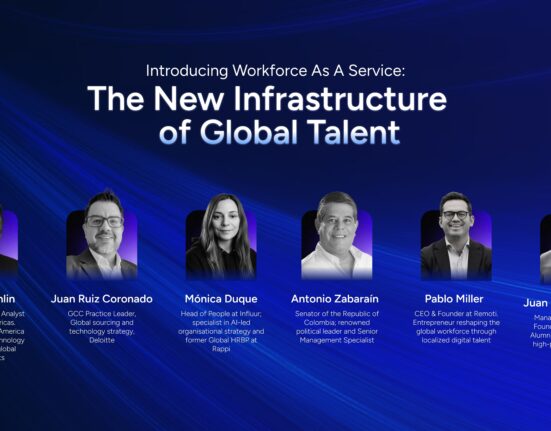
Talent gets similar attention. “Building Latin America’s New Architecture of Work” looks at how distributed teams, AI-assisted workflows, and on-demand hiring are changing the way companies in the region find and keep people. The programme asks which of these models are delivering measurable results and which are still aspirational. Executives from Salesforce Colombia, Globant, TP MAR, and XTrain are on the panel, so the answers should come from companies already running them.
The rest of the programme reaches beyond business, with sessions on AI governance, planetary health, and Latin America’s position in a multipolar order. Vice President José Manuel Restrepo is the guest of honour.
It is the first time the summit has been held in Colombia and the third year running in Latin America, after Vitória and São Paulo. For founders and investors across the region, that means four days of access to capital and to each other without a long-haul flight.